Trade Breakdown · · 4 min read
1:188 on MNQ: Sunday Asia Open CRT Trade Breakdown
A new personal record taken live in the trading room: an MNQ short at the Sunday Asia open, off the previous day's high, targeting internal liquidity at the H4 FVG.
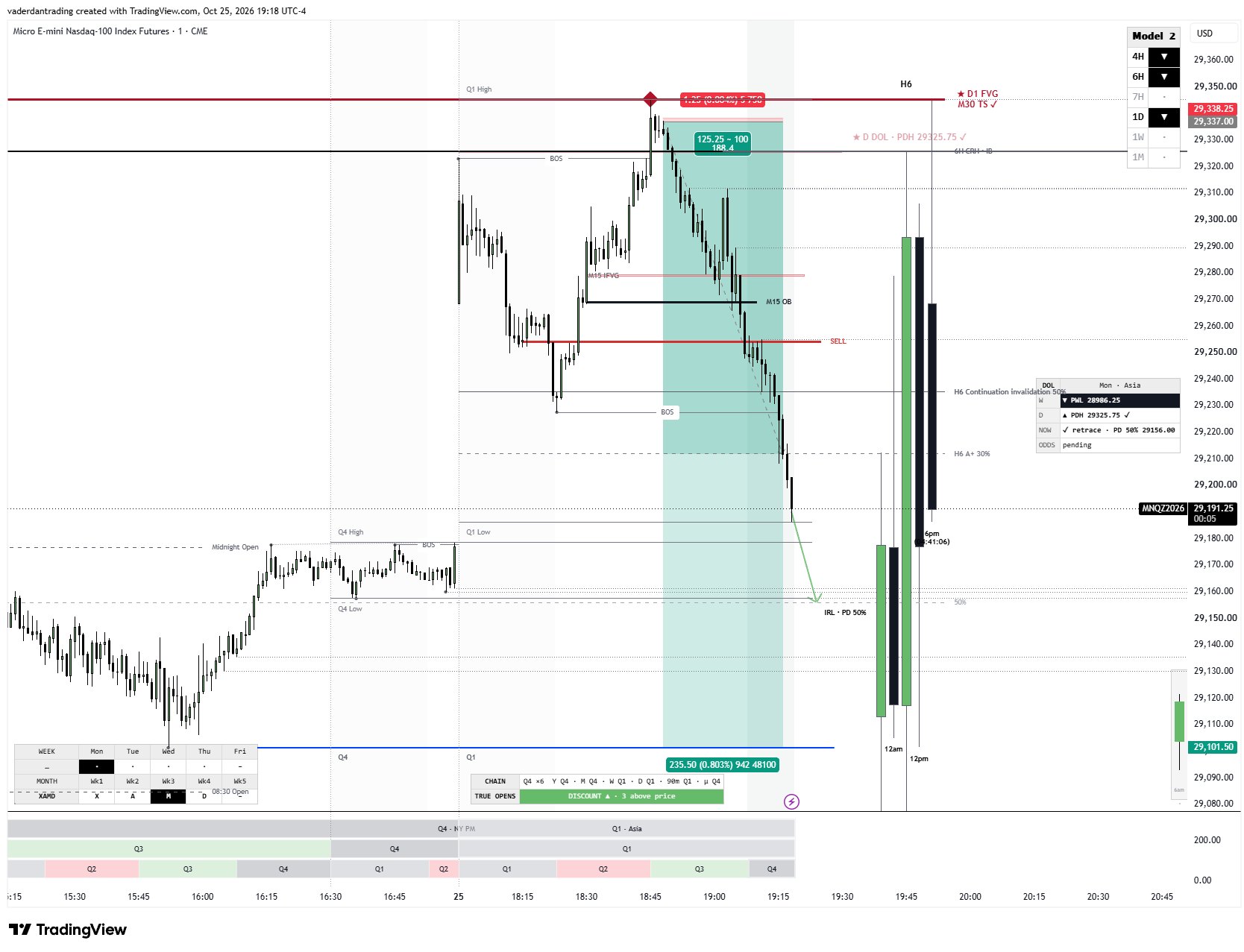
I didn't expect to beat my 1:175 this soon. Tonight, at the Sunday Asia open on the Micro Nasdaq (MNQ), I took a short live in the trading room that paid 1:188.4 — a 1.25-point stop against a 235.5-point target. Here's exactly what I saw and why the risk could be that small.
Honest disclaimer
This is one trade, and it's my new best. Most of my trades are far smaller, and plenty lose. A stop this tight also means you can be taken out by a single tick of noise or slippage. Read this as a breakdown of the structure, not a promise of results.
The trade at a glance
| Detail | Value |
|---|---|
| Market | MNQ (Micro E-mini Nasdaq-100), Dec 2026 contract |
| Date & session | Sunday, October 25, 2026 — Asia open |
| Direction | Short |
| CRT Radar model | Model 2 (H6) |
| Entry | 29,337.00 |
| Stop | 29,338.25 (1.25 points / 5 ticks) |
| Target | 29,101.50 (235.5 points) |
| Result | Target reached — 1:188.4 |
The setup: the market opened straight into a liquidity pool
Sunday opens are often ignored because people assume nothing happens until London. But the first hour of Asia can be violent, and that's exactly what it was tonight.
Price ripped higher off the open and ran straight into two things that were sitting above it:
- The previous day's high (PDH) at 29,325.75. That's buy-side liquidity — stops from shorts and breakout buy orders resting above an obvious high. My indicators had it marked as the daily draw on liquidity before the open.
- A daily fair value gap (D1 FVG) just above it. An area where price is likely to stall and reject, not keep running.
So the market had a reason to go up — take the PDH — and a reason to stop — the daily FVG. That's the Candle 2 purge in CRT terms: run one side of the range, then fail.
The confirmation: the 30-minute turtle soup
Taking a high isn't an entry by itself. For Model 2 on the CRT Radar I need a 30-minute turtle soup at the Candle 2 high: a 30-minute candle runs the previous 30-minute high beyond the range and then closes back below it.
That printed right at the D1 FVG after the PDH was taken. The run above the high had failed — buyers who chased the breakout at the open were now trapped above the market.
Why the stop was only 1.25 points
This is the whole trick behind numbers like 1:188. The invalidation is the high of the purge. If price trades back above it, the idea that the run failed is simply wrong.
I shorted at 29,337.00 with the stop at 29,338.25 — just beyond the purge high. Five ticks. That's not a stop you set because it's comfortable; it's a stop that's only valid because the turtle soup defined a precise level where the trade stops making sense.
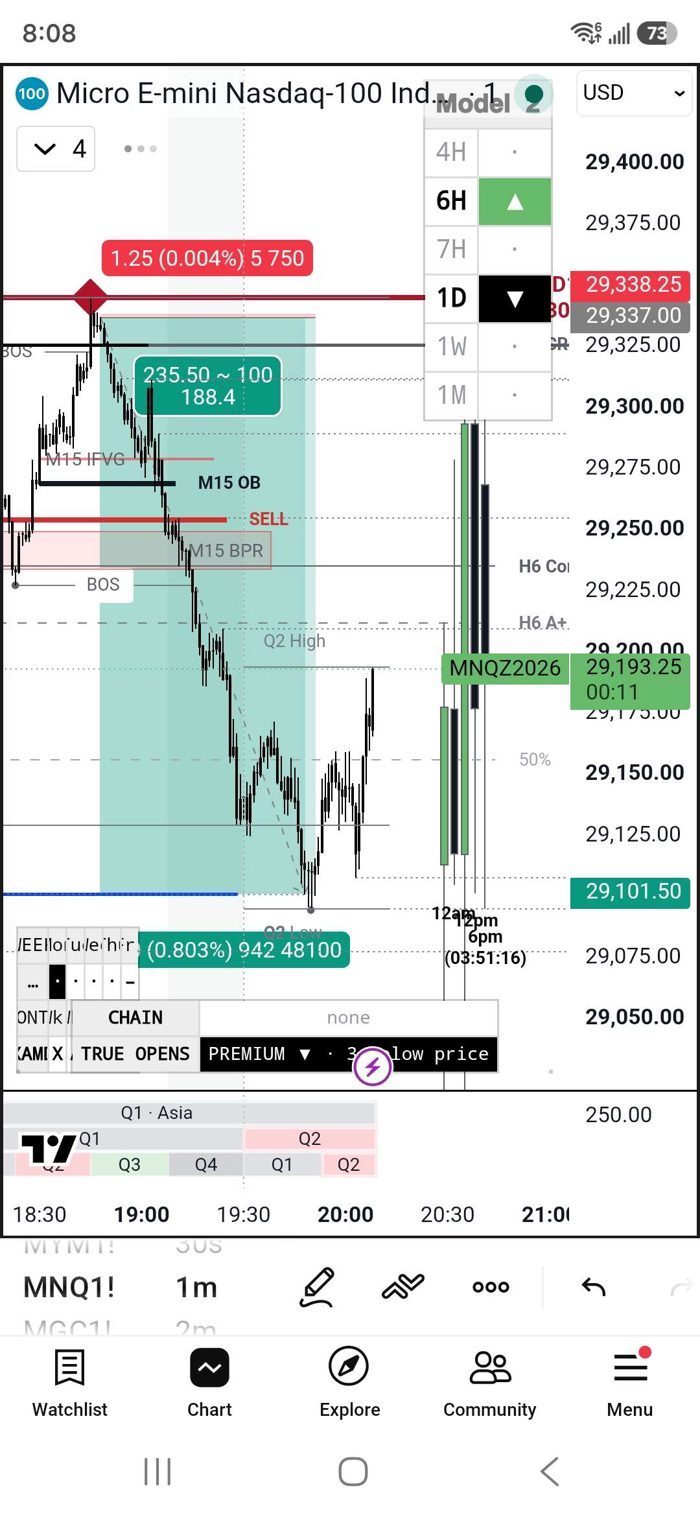
As price fell, the Radar printed the follow-through on M15 — an inverse FVG, an order block, a balanced price range and its sell signal. Those are the entry requirements a trader who missed the top could still have used, with a wider stop and a smaller R.
The target: internal range liquidity at the H4 FVG
Shorts after a liquidity grab are only as good as their target. I wasn't aiming for some random number; I was aiming for internal range liquidity (IRL) — the H4 fair value gap below, at 29,101.50. Price had left that inefficiency on the way up, and markets tend to rebalance it once the external high has been taken.
So the plan was: external liquidity taken above (PDH), deliver back into internal liquidity below (H4 FVG). From 29,337.00 down to 29,101.50 is 235.5 points. Divide by a 1.25-point stop and you get 188.4.
Price got there within the session. The phone screenshot above is from after the move, with the low tagging the target level.
What I'd take from this as a prop firm trader
- Don't sleep on the Sunday open. The first hour of Asia regularly runs an obvious high or low from Friday before the real direction shows up.
- Precision comes from the confirmation, not the target. The 1:188 exists because the turtle soup gave a level so precise I could risk five ticks.
- Respect the downside of a tiny stop. On a prop account I size these so a stop-out is a non-event. Slippage on a fast open can turn a five-tick stop into ten.
- Know your draw on liquidity before the open. I knew PDH was the magnet above and the H4 FVG was the target below before price got there. The trade just confirmed it.
Trade it with the same tools
This was Model 2 on the CRT Radar, with the daily draw on liquidity marked on the chart by the rest of the Vaderdan suite. The full rule set — the models, the turtle soup, stop and target placement — is in the CRT Handbook, and buying it includes access to the Radar suite.
I call trades like this live in the Discord trading room, and every trade I take — wins and losses — goes on the daily results page.